The Globe Post: “Attempted US Capitol Coup a Security and Existential Crisis” (Mar. 3, 2021)

“We have trained ourselves to think of justice as equivalent to authority, power, and obedience. It’s no surprise, then, that people who appear obedient are treated differently than their ‘disobedient’ counterparts. It’s a rhetorical problem that produces a violent reaction.”

Read the rest at: https://theglobepost.com/2021/03/03/capitol-coup-rhetoric/

Public Seminar: Trump Lied His Way In and Is Lying His Way Out: What 20th-Century Fascists Can Teach Us about the Need for Truth in the 21st-Century (Dec. 10, 2020)

“I have spent more than five years studying fascist rhetoric and demagoguery and in particular the relationship between truth and facts in fascist regimes. Unsurprisingly, perhaps, one of the main lessons I’ve learned is that facts and truth have a very uneasy relationship in fascism – but I have also learned that fascist rhetoric relies on an unusual definition of what truth is, and what role it should play in political culture.”

Read the rest at: https://publicseminar.org/essays/trump-lied-his-way-in-and-is-lying-his-way-out/

Arc Digital: “Shitposting for Fun and Profit: Memes, Rhetoric, and Russian Trolls” (Oct. 7, 2020)

“People can understand what’s going on if they know to look. If you think of memes as sophisticated methods of communication, with different messages communicated in different contexts, you probably won’t uncover a Russian plot. But you’ll be more aware of what people are trying to persuade you to believe — what appetites they’re creating in you and what satisfactions they’re encouraging.”

Read the rest at: https://medium.com/arc-digital/shitposting-for-fun-and-profit-f8eca394e213

The Fulcrum: “A Good Democracy Requires Disagreement, Conflict and Argument” (Oct. 7, 2020)

“Civil or not, democracy is designed to let people argue their differences out and come to a compromise that serves the good of the whole. In other words: Disagreement, conflict and argument are a feature of democracy, not a bug.”

Read the rest at: https://thefulcrum.us/big-picture/civil-discourse

The Hill: Checking Facts is the Wrong Way to Understand Political Persuasion (Sept. 1, 2020)

“If news organizations really want to understand what’s happening in campaign communications and help their consumers understand it, too, they’d do well to back off fact-checking. Instead, they should learn to focus on what feelings and passions are being stimulated and what values and beliefs that can help potential voters understand.”

Read the rest at: https://thehill.com/opinion/campaign/514564-checking-facts-is-the-wrong-way-to-understand-political-persuasion

Pass Your Passion Podcast: “Ryan on Fascism Research, Truth, and Rhetoric” (Summer 2020)

“I talk with my friend and colleague, Ryan, about his work on fascism research, distinctions between fact and truth, and the role rhetoric has in our political and social spheres, this and occasional references to the set up of his office, where we chat, (before shelter-in-place)in San Jose, California.”

Listen to the rest at: https://soundcloud.com/passyourpassionpodcast/episode-18-ryan-on-fascism-research-truth-and-rhetoric

No, You’re Hitler!: A History and a Proposal

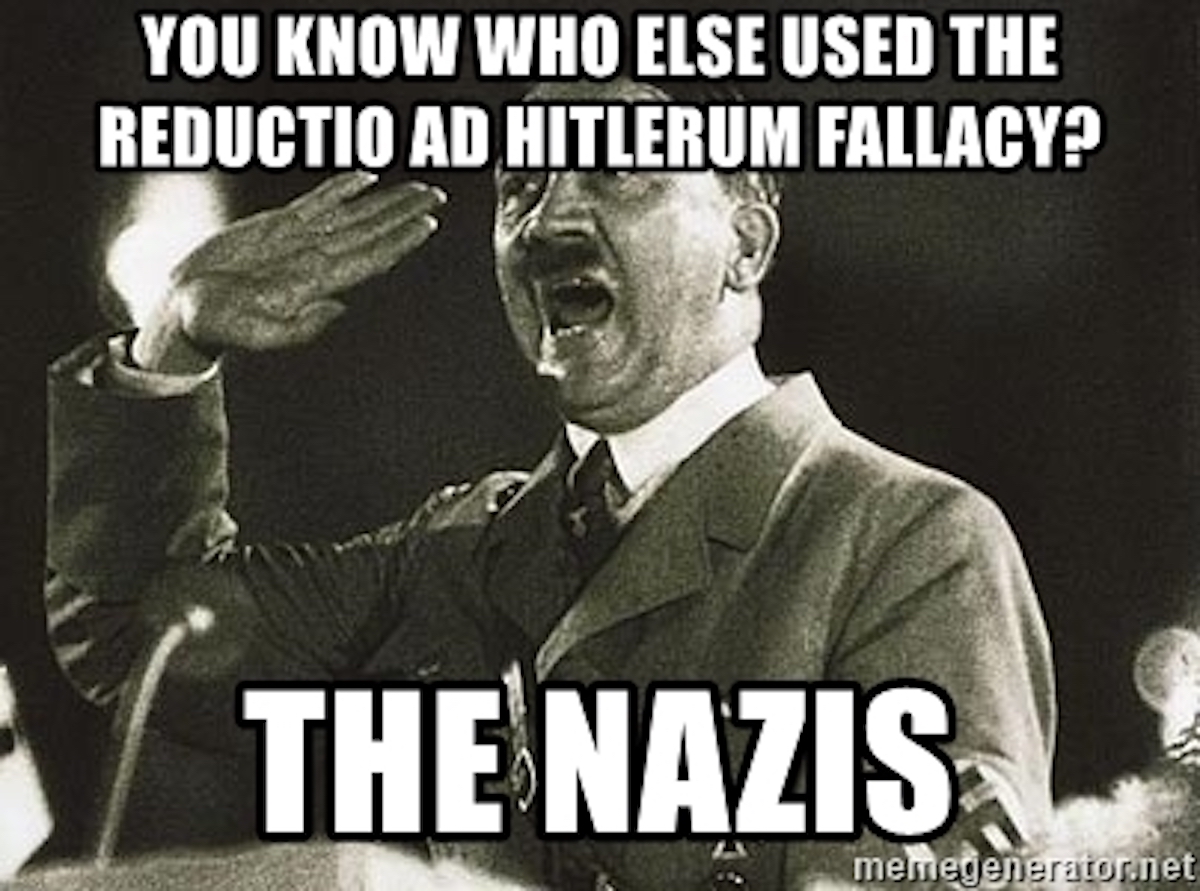
In 1953, famed political philosopher and Jewish-German exile, Leo Strauss, coined a term to describe a trope that he increasingly saw circulating in public discourse: reductio ad Hilterum. Reductio ad Hitlerum is a fallacy used in arguments to discredit anything that can be associated with or compared to Hitler. Hitler liked dogs? Then liking dogs is discredited. Hitler was a vegetarian? Discredited. A teetotaler? Discredited. And so on.

Strauss’s identification of reductio ad Hitlerum was little more than a footnote to his main point about social science and political philosophy in the 20th century. Nevertheless, he gave us a very useful shorthand for describing a prevalent form of public argument, and it’s one we’d do well to understand because it continues to play an important role in public debates, though perhaps not in the way we’d expect.

In the years since Strauss’s book was published, reductio ad Hitlerum (or argumentum ad Hitlerum) has remained popular in public discourse. It has been used to make more or less credible comparisons to world leaders such as Joseph Stalin, Pol Pot, Idi Amin, and others, for instance.

It has also been leveled at people like Mother Theresa, Jimmy Carter, and Albert Einstein (which is especially galling, considering that he and his family fled Germany in 1932 to escape the Nazis). In fact, it’s quite likely that every world leader, and perhaps any leader of anything, from a Fortune 500 company to a Girl Scout Troop, has been compared to Hitler at some point or another. Consequently, as Hitler comparisons accumulated over the years, their usefulness diminished.

By the 1990s, with the rise of the internet—and more importantly, with the rise of arguing on the internet—there were efforts to counteract reductio ad Hitlerum. Most famously, in the early 90s, attorney and author, Michael Godwin, asserted what he called “Godwin’s Law of Nazi Analogies,” often referred to simply as “Godwin’s Law”: “As an online discussion grows longer, the probability of a comparison involving Nazis or Hitler approaches one.” Basically, the longer an internet argument goes on—any argument about any topic—the more likely it becomes that some participant will accuse another participant of being, thinking, or behaving like Hitler or the Nazis.

Godwin called such comparisons a “handy rhetorical hammer” in internet arguments that nevertheless “trivialized the horror of the Holocaust and the social pathology of the Nazis.” Godwin has recently clarified that there are some valid bases for Nazi comparisons and it’s the glib, careless variety that he hoped to quell. Nevertheless, thanks to Godwin and others, Nazi and Hitler comparisons have become something of a joke. They are often dismissed as either too grossly hyperbolic to be useful (Fergal Keane) or, more commonly, desperate and juvenile attempts to win an unwinnable argument. The same principle has largely extended to fascism comparisons more generally.

The point of laying out this short history of reductio ad Hitlerum is to illuminate two enduring consequences for public discourse. The first is that although Hitler plays an important role in public discourse, that role is often quite separate from what Hitler actually did or said. In fact, even when a Hitler comparison is directly keyed into evidence from Hitler’s actual speeches or behaviors, it’s inescapably weighed down by both Hitler’s historical awfulness and by the Straussian-Godwinian renouncement of reduction.

The second consequence, under the circumstances, seems to be an ironic one. As a direct result of the effectiveness of the reductio ad Hitlerum argument, Hitler has become something of a shield in public argumentation. For instance, famed leader of the alt-right movement, Richard Spencer, is an open advocate for white nationalism. In response to accusations that he’s a Nazi, he’s accused his accusers of being closed-minded and afraid of ideas. Comparing someone to Hitler often has the effect of taking the focus off the behavior under consideration and putting it on the legitimacy of the accusation, much in the same way accusing someone of racism is seen by some people as worse than racism.

The curious evolution Hitler comparisons in public discourse puts us in a strange place in the current global political moment. On the one hand, such comparisons are ineluctably weighed down by the historical-Hitler, by resistance to reductio ad Hitlerum, and by the fact that “Hitler” has consequently become a shield in public discourse are.  On the other hand, around the world, there has been a precipitous rise in right-wing nationalisms—many of them violent, hateful, and authoritarian—that echo old National Socialist doctrine. Likewise, fascism is apparently making a grand revival.

We can add other specific Nazi examples. In Germany, a Neo-Nazi candidate was elected mayor in a small village in 2019. In Austria, it was recently discovered that former Vice Chancellor and leader of the far-right Freedom Party, Heinz-Christian Strache, was actively involved in Neo-Nazi groups as a young man. In Brazil earlier this year, Culture Minister Roberto Alvim was fired after delivering a speech that paraphrased and aesthetically imitated a 1933 speech by Joseph Goebbels. And in the United States, as Donald Trump was campaigning for the presidency in 2015, his ex-wife alleged that he used to keep a book of Hitler’s essays next to his bed for inspirational nighttime reading.

In short, there are probably some good reasons to make Nazi, Hitler, and fascism comparisons.

Nevertheless, we can and should take the spirit of Strauss’s and Godwin’s incisive arguments seriously: Hitler, Nazi, and fascism comparisons shouldn’t be made lightly. They should be made with a keen understanding of their affordances and their limits for understanding other events, people, or circumstances. They should also be sensitive to historical fact, underlying assumptions, and ultimate goals.

I’d like to propose that we extend the spirit of reductio ad Hitlerum to reductio ad Hitlerum. We should not invoke it lightly. Just as Hitler, Nazism, and fascism have important historical referents, so do arguments about the arguments—about what counts as legitimate, valuable, and illuminating. We cannot and should not have a blanket policy when it comes to arguments about Hitler or Nazis, and treating reductio ad Hitlerum or Godwin’s Law as universally applicable—especially when their authors would not—is as unhelpful as seeing Hitler in everything.

I realize this proposal has about as much chance of being universally adopted as Godwin’s law had at preventing glib Hitler references on the internet. Still, it seems to be a goal worth aiming for, especially as public discourse and global politics seems more and more to echo our most polemical historical examples.

Initially posted at: https://dissoitopoi.home.blog/2020/08/25/public-discourse-in-the-spirit-of-reductio-ad-hitlerum-a-history-and-a-proposal/

Nazi Science: Coronavirus Edition

Noted flim-flam artists and doctors of low repute — including Dr. Oz and Dr. Phil — have recently been trotted out by right-wing media outlets to bemoan Coronavirus social distancing directives as “worse than the disease.”

Likewise, small groups of radical, right-wing extremists — funded by the same astroturf groups that quietly funded the Tea Party protests in 2010 and organized by right-wing extremist groups like those that organized the “Unite the Right” hate parade in Charlottesville in 2017 — have exercised their inalienable right to gather in close proximity and whip out their unambiguously-phallic assault rifles, their Confederate flags, and their MAGA hats. Among other things, they’ve called for the jailing (or killing) of Democratic politicians, advocated the firing of the nation’s foremost health experts, and blocked hospital entrances in the name of protesting social distancing.

All the while, right-wing politicians and media personalities have gleefully egged them on with inflammatory tweets, radio programs, and press conferences that undermine the guidance of the country’s top medical experts (in some cases while said experts are standing next to them on the dais).

Reactions from people basically everywhere else on the political spectrum have ranged from anger to astonishment to confusion. Recent polling (e.g., here and here) indicates that people across the political spectrum oppose the protests and are more concerned about lifting restrictions too early than they are about letting them carry on too long.

In a recent editorial, Rich Lowry, editor of the conservative National Review, called anti-lockdown arguments tendentious, perverse, and sneering. The Louisville Courier Journal Editorial Board dubbed one Kentucky protest “a pro-coronavirus rally.” In his popular politics and gay rights blog, Joe.My.God, Joe Jervis has taken to calling people who defy social distancing guidelines “Branch Covidians.” And in the New York Times, Charlie Warzel called the protests “a march for the freedom to be infected.”

Warzel makes the argument that these rallies are the logical — if extreme — conclusion of the right-wing’s “perverted liberty ideology.” Radically anti-government and anti-authority (but ironically pro-authoritarian), Warzel contends that this political ideology represents a “wholesale rejection of collective thinking.”

This wholesale rejection of collective thinking is puzzling and concerning for most Americans, and it’s worth asking where it comes from.

The answer is not “the Nazis,” but as it happens, the Nazis do shed some useful light on the line of thinking that says “re-opening the economy” (which is a ridiculous phrase, by the way) is more important than saving people’s lives.

In his 1978 biography, Hitler: A Study in Personality and Politics, historian William Carr outlines some of the major intellectual currents that influenced Hitler and the Nazis. Foremost among them was Social Darwinism.

As Carr notes, Social Darwinism is the “notion that life is in essence a ruthless struggle for existence, bellum omnium contra omnes (the war of all against all).” Social Darwinism is a fundamental distortion of Charles Darwin’s biological theories, which, as Carr argues, “led, in some quarters at least, to the emergence of a highly pessimistic view of man, no longer a moral being infused with a divine spark, but a simple biological organism and an expendable unit in a collective entity” (113).

Hitler’s views on Social Darwinism have been very well-catalogued over the years. He believed, in essence, that the races were in a great, cosmic battle for survival, and that it was not only natural, but imminently moral, for the strong to ruthlessly crush the weak. Social Darwinism deeply influenced his politics, as well as his views on racial science and eugenics. What Hitler and the Nazis did was take Social Darwinism to a logical, but radical, extreme.

According to Carr, however, the notion of “a war of all against all” was commonplace in late-19th/early-20th century Europe, and it revolved around the idea that civilization unnaturally constraints human nature.

The restraints civilization had placed on human rapacity were dismissed by extreme Social Darwinists as a perversion of the evolutionary processes which decreed that the fittest and the strongest should survive at the expense of the unfit. Humanitarian efforts to protect the weak, the sick, and the old distorted the balance of nature. (113)

It’s not too far a leap to get from this notion of “a war of all against all” to Dr. Oz’s affable remark on Sean Hannity’s show that, “opening of schools may only cost us 2 to 3%, in terms of total mortality. Any, you know, any life is a life lost, but…that might be a trade-off some folks would consider.”

If your view of nature in general, and human nature in particular, is that the weak should be sacrificed to strengthen the strong, then what’s 2–3% of school-aged children, right?

If you’re convinced that protecting the weak, the sick, and the old is a perversion of natural evolutionary processes, then enforcing social distancing to protect the weak, the sick, and the old — that is, the people most likely affected by Coronavirus — is in fact a gross distortion of the balance of nature.

Let Grandma and Grandpa sacrifice themselves for the economy. It promotes the growth of strong and healthy elements! (After I posted this story, Dan Patrick reiterated his support for the economy over human life.)

There is no reason, necessarily, to believe that Dr. Oz, the Pro-Coronavirus protestors, or Alex Jones know that they’re invested in the ideology of Social Darwinism (though some of them surely do). But it’s not for nothing that radical right-wing extremism in 21st century America is a direct descendant of radical right-wing extremism in 20th century Germany. And, more to the point, Branch Covidians’ behavior relative to the Coronavirus shutdown (and frankly, relative to all their social and political beliefs) suggests that they readily accept the basic premise of Social Darwinism, and equally, that they think they will win in “a war of all against all.” Hence all the guns.

Ultimately, it doesn’t much matter if they know their ideological ancestors. What matters is they’re putting people lives at risk, and they’re doing it on purpose. Because, ultimately, they don’t see the loss of “social undesirables” — that is, people who are weak, sick, old, or otherwise “tainted” — as a loss at all. They see it as a renewal of natural selection and a revival of their “right” to be strong.

Initially posted at Medium: https://ryan-skinnell.medium.com/nazi-science-coronavirus-edition-bac4c2a0ed15

Demagoguery and the Dangers of “Extreme Democracy”

I recently published an academic article, “Using Democracy Against Itself: Demagogic Rhetoric as an Attack on Democratic Institutions,” where I wrote about “extreme democracy” as a form of demagoguery (The abstract is here. If you want to read the whole thing, get in touch). Specifically, I argued that a consistent—perhaps defining—characteristic of demagoguery is that it hyperextends or supercharges direct democracy in order to undermine democratic institutions.

I thought it might be worth glossing my argument here because what I wrote about in that article is on full display in the Senate impeachment hearings.

The concept of “extreme democracy” or “rampant democracy” comes from Aristotle. In The Politics, written in about 350 BCE, Aristotle produced a taxonomy of the different kinds of governance: monarchies, oligarchies, and democracies. For Aristotle, oligarchies are vastly superior to monarchies because monarchies eventually tend toward tyranny. No big surprises there.

Probably also no surprise, democracies are better than oligarchies. According to Aristotle, democracies are the best form of governance because they are “safer and more permanent” and “more relaxed and gentler” than oligarchies. Yay democracies!

Continuing with our theme of “no surprises,” however, democracies aren’t without their challenges. The major problem is that unlike tyrannies and oligarchies, democracies are susceptible to demagogues. Aristotle doesn’t provide an explicit definition of “demagogue” in The Politics, but what he does say is this:

[I]n democracies which are subject to the law the best citizens hold the first place, and there are no demagogues; but where the laws are not supreme, there demagogues spring up. … At all events this sort of democracy, which is now a monarch, and no longer under the control of law, seeks to exercise monarchical sway, and grows into a despot; the flatterer is held in honour [sic]. … The decrees of the demos correspond to the edicts of the tyrant; and the demagogue is to the one what the flatterer is to the other.

There are two things I want to point out here. First, for Aristotle, the demagogue is not the same as a tyrant. Elsewhere he calls demagogues “aspirants to tyranny,” and it’s useful to think of the ways that demagogues try to move a democracy toward tyranny. Which is why the second thing worth pointing out is Aristotle’s warning that a democracy under the sway of a demagogue becomes like a tyranny.

Aristotle maintains that this form of governance is a democracy, inasmuch as the people have the power in their hands. But much to his chagrin, the people collectively act as a monarch. In this form of democracy, “not the law, but the multitude, have the supreme power, and supersede the law by their decrees.” For Aristotle, the fundamental perversion of this form of democracy is not simply that the people rule as one, but that this form of rule inverts the popular will and the supremacy of the laws.

This is where his term “extreme democracy” comes into play. One way to read Aristotle’s description of demagogues is that they seize state power. Another way to read it, however, is that demagogues do not thwart democracy directly so much as they supercharge it. He writes, “The demagogues make the decrees of the people override the laws, and refer all things to the popular assembly. … Further, those who have any complaint to bring against the magistrates say, ‘let the people be judges;’ the people are too happy to accept the invitation; and so the authority of every office is undermined.”

By referring all matters to the popular assembly, the demagogue makes democracy extreme, and extreme democracy eventually destroys itself.

Here’s a recent, (not so) hypothetical example. Let’s imagine a member of the Supreme Court dies. By law, the sitting President should appoint a new justice and the Senate should “advise and consent” on the appointment. But instead, the Senate majority leader declines to take up the nomination, claiming “the American people should have a say in the court’s direction.” The Senate majority leader then stalls the process for nearly a year, asserting that since it is an election year, “the American people have a particular opportunity now to make their voice heard … in the process to select their next president—as they decide who they trust to both lead the country and nominate the next Supreme Court justice.”

In this example, rather than upholding the legal, institutionally-defined process, the Senate majority leader turns the Senate’s responsibility over to the popular assembly. By supercharging democracy in this way, the Senate majority leader undermines democracy and does irreparable damage to democratic institutions (i.e., the Senate, the Supreme Court, and the executive branch). He appears to be super, extra democratic by having “the people” weigh in, but actually he’s abandoning his own responsibility and leading rhetorical attacks against democratic institutions’ legitimacy by amplifying and channeling the will of the people. In short, he’s destabilizing the institutions he’s directly responsible for safeguarding.

In recent weeks, Donald Trump’s impeachment trial has provided another good example of attempts to supercharge democracy. As David A. Graham writes in The Atlantic, “The White House’s messaging throughout the impeachment process has been wildly inconsistent on nearly every count save one: Democrats are trying to overturn the 2016 election.” His legal team made that case explicitly during the Senate trial. In other words, efforts to hold the President accountable are characterized as attempts to rebuke the popular assembly. It’s a barely concealed attack on democratic institutions because it attempts to remove their legal, institutional oversight authority and place it in the hands of “the people.”

In the coming months, impeachment will undoubtedly hold center stage in campaign messages of Democrats and Republicans alike. As the campaign messages unfold, “the people” will inevitably be a common refrain. But it will be important to watch where “the people” is used as an appeal to supercharge democracy in ways that attack and undermine the legitimacy of democratic institutions. Because the more we invest in “aspirants to tyranny,” the closer we come to losing our democracy. And the way we avoid that is by paying attention to who we elect and how they talk about what elected officials should do with their responsibility.

All Aristotle quotes were taken from Benjamin Jowett’s translation of The Politics.

ADDENDUM: Today on Meet the Press, Senator Lamar Alexander explained his decision to oppose impeachment in this way: “Now it’s up to the American people to say, ‘Okay, good economy, lower taxes, conservative judges, behavior that I might not like, call to Ukraine.’ Weigh that against Elizabeth Warren or Bernie Sanders and pick a president.” Translation: ‘Let the people be judges.’

Initially posted at: https://dissoitopoi.home.blog/2020/02/02/demagoguery-and-the-dangers-of-extreme-democracy/

Maybe Let’s Leave “I Don’t Care” to the Fascists, Yeah?

Beginning as early as 2009, a series of memes began circulating on social media that were intended to demonstrate in comical ways the lack of interest or care someone felt on a particular day or about a particular issue. Colloquially, they’re the “Look at all the fucks I give” memes, with the unmistakable implication that the poster gives none. (That the original version was an animated .gif of anti-fascist icon, Maria, from The Sound of Music is terribly ironic in retrospect, as will become clearer below.)

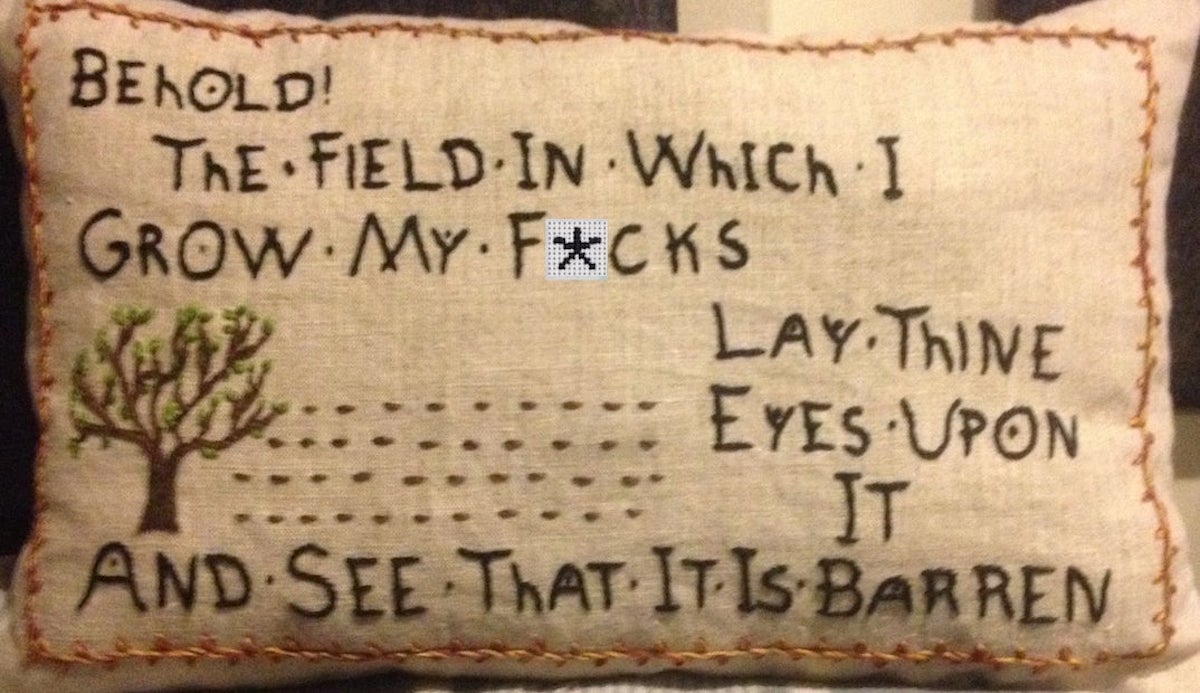
The circulation of “Look at all the fucks I give” memes has only intensified in the subsequent decade, and it has become recognizable enough as a meme to appear in other media as well. In 2018, Hank Green’s New York Times bestselling debut novel, An Absolutely Remarkable Thing, included the following passage: “Manhattan is less legit than it once was, for sure, but this is still the city that never sleeps. It is also the city of ‘Behold the field in which I grow my fucks. Lay thine eyes upon it and see that it is barren’” (pg. 8). That specific version of the sentiment is now a fixture in the ever-roiling meme library, and it also appears in whimsical cross-stitches and embroidered throw pillows on Etsy.

In recent years, demonstrating detachment has proliferated well beyond the meme-o-sphere, as well. In 2016, blogger and self-help guru Mark Manson published a New York Times bestseller bearing the provocative title, The Subtle Art of Not Giving a F*ck. The title is misleading given what Manson advocates, but it picks up nicely on the tone of the meme. Likewise, two years after Manson’s book came out and just three months before Green’s novel was published, Melania Trump sparked controversy when she arrived in Texas to visit children in detention camps on the southern US border wearing a jacket that said “I DON’T REALLY CARE DO U?”

My goal here is not to exhaustively document the apparent lack of care in contemporary culture. I don’t actually believe that the prevalence of the sentiment is true to any significant degree. In my experience, the people most apt to use say they don’t give a fuck or don’t care actually tend to care a great deal. Which is why I think it’s time to consider retiring the phrase(s), and frankly, the whole attitude.

Before I get to that, however, I want to note two phenomena about the fallow grounds of caring—the first being the evolution of “I don’t care” from a social media joke into something of a slogan. You can see it most clearly in Green’s use of the meme to describe Manhattan, but its equally obvious in Trump’s interview, in which she said of her jacket that is was “for the people and for the left-wing media who are criticizing me. And I want to show them that I don’t care.” In both the Manhattan and Trump examples, not caring isn’t enough. Boldly demonstrating that you don’t care is the point. “I don’t care” is not just a clever quip, it’s an identity marker. It’s who you are and who you want people to see you being. Not for nothing in Trump’s case, it comes straight out of her husband’s media strategy playbook.

The second related phenomenon I want to note is a historical one. A century ago, Fascism was on the rise in Italy. Not just vaguely authoritarian groups, mind you—the literal Fascists. In about 1920, supporters of Benito Mussolini and Gabrielle D’Annunzio (a Fascist intellectual and early party leader), recycled a WWI song called Me Ne Frego to celebrate the growing vitality of the Fascist movement. “Me ne frego” translates roughly to “I don’t give a fuck.”

Before long, Mussolini had adopted the slogan “me ne frego” as a guiding philosophy of Fascism. It symbolized for Mussolini and his Fascists the drive to live boldly and daringly without regard for the consequences, which might even include death. For the Fascists, “me ne frego” encapsulated a worldview that venerated speed, masculinity, violence, and action.

“Me ne frego” was an attitude.

I mean “attitude” in a technical, rhetorical sense. I’m borrowing the term from Kenneth Burke, who was a writer, literary theorist, and rhetorician in the 20th century. In fact, Burke was beginning his career in Greenwich Village at almost exactly the same time that Mussolini and D’Annunzio’s supporters were reworking their Fascist ditty.

Burke is surely not the only person to think and write about attitudes, but he was thinking and writing about them at the same time the Fascists were in power and in relation to the Fascists. And while his concept of attitudes can be complicated, we don’t have to go into all its complexities for it to be useful.

In Contemporary Perspectives on Rhetoric: 30th Anniversary Edition, Sonja K. Foss, Karen A. Foss, and Robert Trapp explain attitudes. Quoting Burke’s A Grammar of Motives, they note that attitude is “‘the preparation for an act, which would make it a kind of symbolic act, or an incipient act.’…In other cases, an attitude may serve as a substitute for an act—as when, for example, ‘the sympathetic person can let the intent do service for the deed’” (pg. 200).

In short, attitudes prepare us to see the world from particular perspectives and act in certain ways as a result. Or at the very least, attitudes prepare us to demonstrate to others that we share their values. So when I say “me ne frego” was an attitude, what I mean is that it prepares people who think of it as a guiding philosophy to act and perform in certain ways. For the Fascists, it literally prepared them to try to overthrow societal conventions and norms, commit acts of violence, and commit themselves to death if necessary to serve the Fascist cause. (Incidentally, they didn’t really have much of a cause beyond “be fascist.” Of course, they claimed to have a cause, but it was never achievable.)

There’s one other point worth borrow from Burke, and then I’ll set him aside. In another of his books, Attitudes Toward History, he helps us see why language and symbols are so important in the development of attitudes. He notes in his introduction that “a group’s routines can become its rituals, while on the other hand its rituals become routines. Or, otherwise put: poetic image and rhetorical idea can become subtly fused—a fusion to which the very nature of poetry and rhetoric makes us prone” (pg. xii).

Let me translate: we build our attitudes through language and symbols, and in particular through the repetition of certain language and symbols. At first, certain words, slogans, catchphrases, and poetic images seem (to us) to explain the world. But eventually, through repetition, they become the limits on the possible ways we are able to see the world. And how we see the world prepares us to act in certain ways.

So back to the barren meme fields of “Look at all the fucks I give”—which again, is none. As I noted above, there are a variety of ways people who use the memes and the “I don’t care” attitudes do it—often, for instance, sarcastically. But as the history of the phrase hopefully makes clear, “I don’t care” nevertheless coaches particular attitudes that persist beyond the joke itself. “I don’t care” prepares people to see and think—and eventually act—in particular ways.

What concerns me particularly is the sloganized version of the sentiment that is so nicely highlighted by the Melania Trump example above. Whatever her intention, her coat coached a particular attitude. It prepares her to see every action as one of provocation, and it prepares us—all of us—to see every one of her actions through the same lens. Even when she’s visiting kids in detention camps. Once we are prepared—once we have adopted the attitude—provocation becomes the point even in situations where the point should be (and is supposed to be!) care.

Ultimately, in a media environment where context is often lacking, where fascist and nationalist radicalization is rampant, and where proto- and neofascist groups thrive on disaffection, it’s far easier to hear “I don’t give a fuck” as “me ne frego” than as “I’m just kidding,” whatever the initial intent may be. Given that reality, I think anyone who doesn’t sympathize with fascists—old or new—would be wise to abandon the meme and its attendant attitudes. Fascists won’t—the better to identify them by. But more importantly, given how much we need care in the world right now, I think we’re wise to invest in giving a fuck.

Initially posted at: https://dissoitopoi.home.blog/2020/01/03/maybe-lets-leave-i-dont-care-to-the-fascists-yeah/